Key Takeaways
- A review of ROKU KYOTO, the only LXR hotel in Japan (one night, November 2025, peak autumn-leaf season)
- Set on the Tenjin River at the foot of the Takao hills: not a base for sightseeing, but a place to stay in Kyoto's quiet
- Room, marble bathroom, TENJIN restaurant and breakfast, with plenty of photos
Introduction: Why ROKU KYOTO?
When you think of a hotel in Kyoto, you probably picture somewhere downtown, around Higashiyama or Kawaramachi. ROKU KYOTO is different. It sits a short drive from the city center, at the foot of the Takao hills in northwest Kyoto, beside the Tenjin River (also called the Kamiya River). The name "ROKU" (麓) literally means "the foot of a mountain."
The hotel holds a special title: it is the only property in Japan from LXR Hotels & Resorts, Hilton's luxury collection. The fact that Japan's sole LXR chose this quiet setting, rather than the heart of the tourist district, says a lot about what ROKU is trying to be.
This was actually my third stay since the hotel opened. I keep coming back for two reasons: the chance to enjoy true luxury in a secluded, peaceful setting, and the fact that ROKU KYOTO is eligible for the free weekend night certificate that comes with my Japanese Hilton co-branded credit card.
On my first visit I stayed in a room facing the pool, and on my second, a second-floor room facing the courtyard. Both were lovely, but one thing bothered me: people walking past. In a courtyard-facing room, guests on the outdoor walkway can see in, so it was hard to fully relax by the window with that beautiful view (just my personal opinion).
Room tip: If you get a courtyard-facing room and have any say in the floor, go for the 4th floor (the top floor). This time I asked for the 4th floor, and it was absolutely the right call.
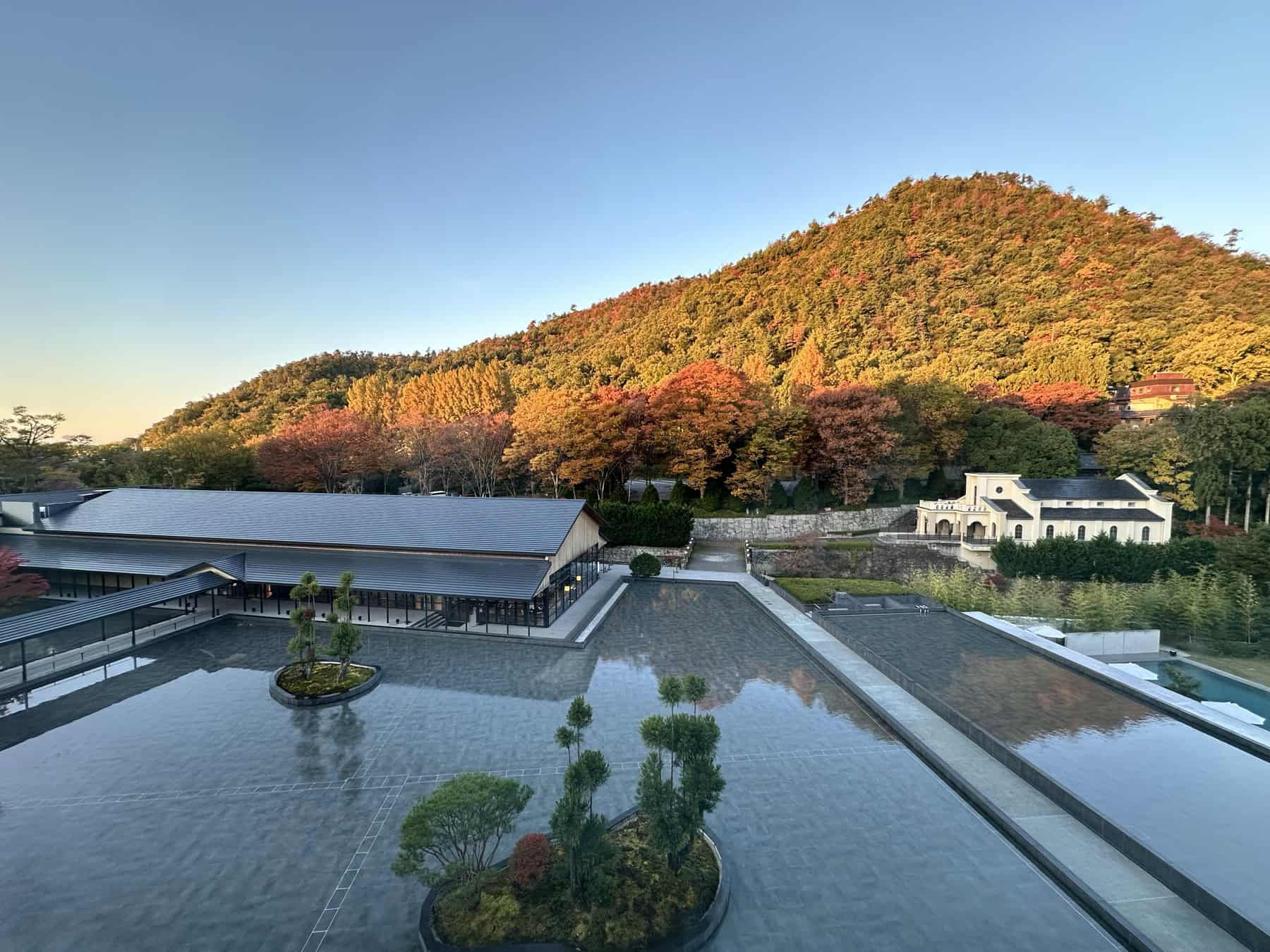
I stayed on November 15–16, 2025 (one night), right at the peak of Kyoto's autumn colors. When I arrived, the blazing red hills of Takao were mirrored in the hotel's large reflecting pool.
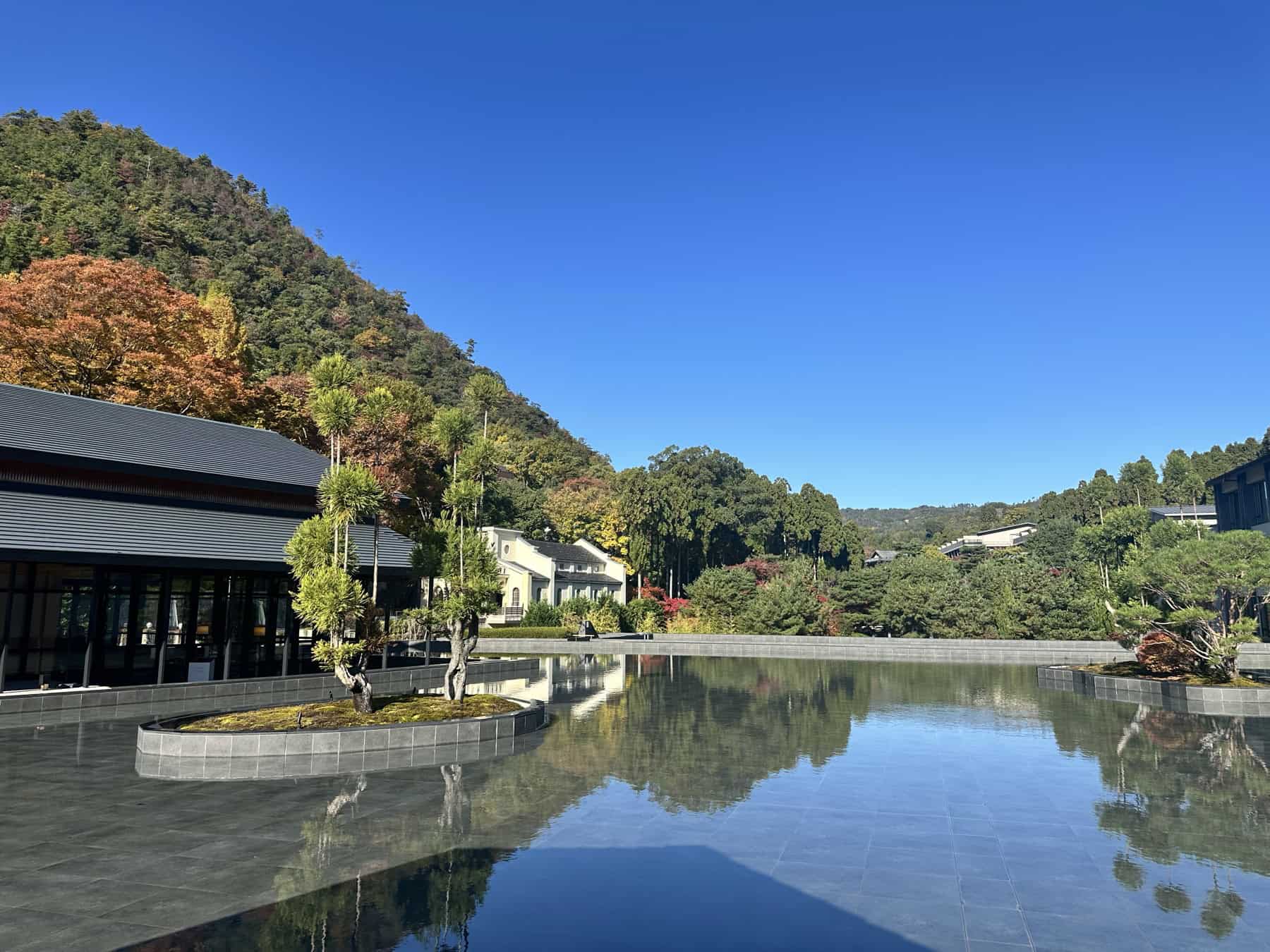
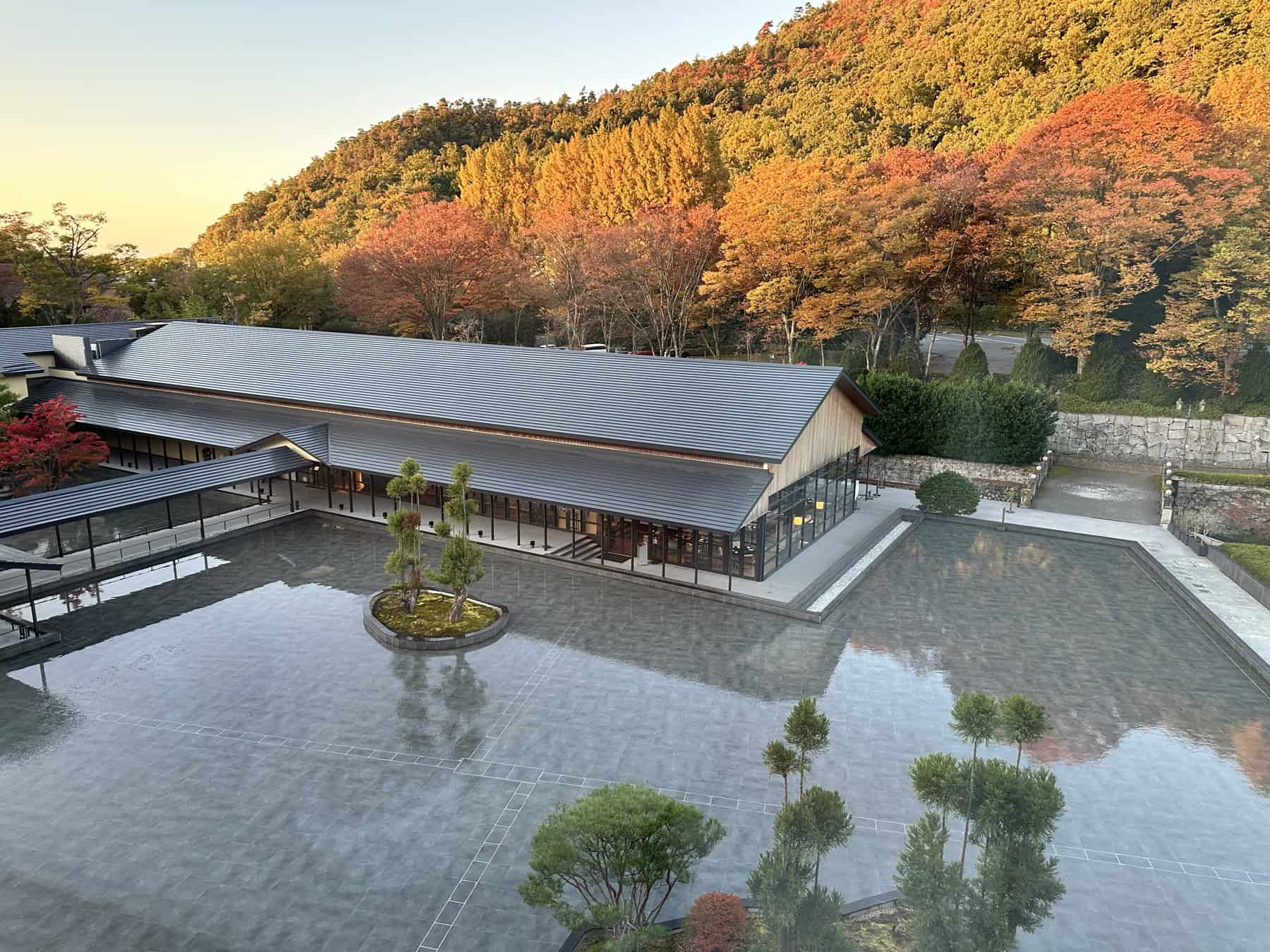
Take a look at the tree just right of center in the photo. It is a Kitayama cedar grown in the traditional daisugi style, and it is also the motif of the ROKU KYOTO logo (the logo is actually modeled on the cedar in front of the entrance). This single tree, a symbol of Kyoto's forestry culture, quietly completes the view across the water.
Getting There: What to Know About Public Transport
Honestly, access from the city is not easy. A private or rental car is no problem, but public transport takes some effort. On my first visit I took a local bus, and with a large suitcase I ended up blocking the aisle, which was a little uncomfortable.
Learning from that, this time I took Kyoto Station → Kyoto Municipal Subway Karasuma Line → Kitaoji Station → taxi. The train takes about 13 minutes and the taxi a little over 10 minutes, and it was by far the most comfortable option (I did the same in reverse on the way back).
The Concept: An "Artist Residence"
ROKU KYOTO's design concept is an "artist residence." It draws on the artists' village that Hon'ami Kōetsu founded in Takagamine in the early Edo period, and reinterprets traditional Kyoto craftsmanship in a modern way. What I find especially interesting is that each area of the hotel is assigned its own craft material.
| Area | Theme material |
|---|---|
| Guest rooms | Karakami (woodblock-printed paper) |
| Lobby and public spaces | Urushi lacquer |
| Restaurant TENJIN | Bamboo |
| Spa | Ceramics |
The history of papermaking carried out along this river in the Heian period also runs through the hotel's name and design. It isn't just luxurious; the way it translates "the memory of the land" into architecture and service feels very LXR.
Check-in: A Luxurious Wait for the Room
When I arrived, my room wasn't ready yet, so I had a short wait. I was shown to a corner of the restaurant, where I ordered a café latte and cake set.
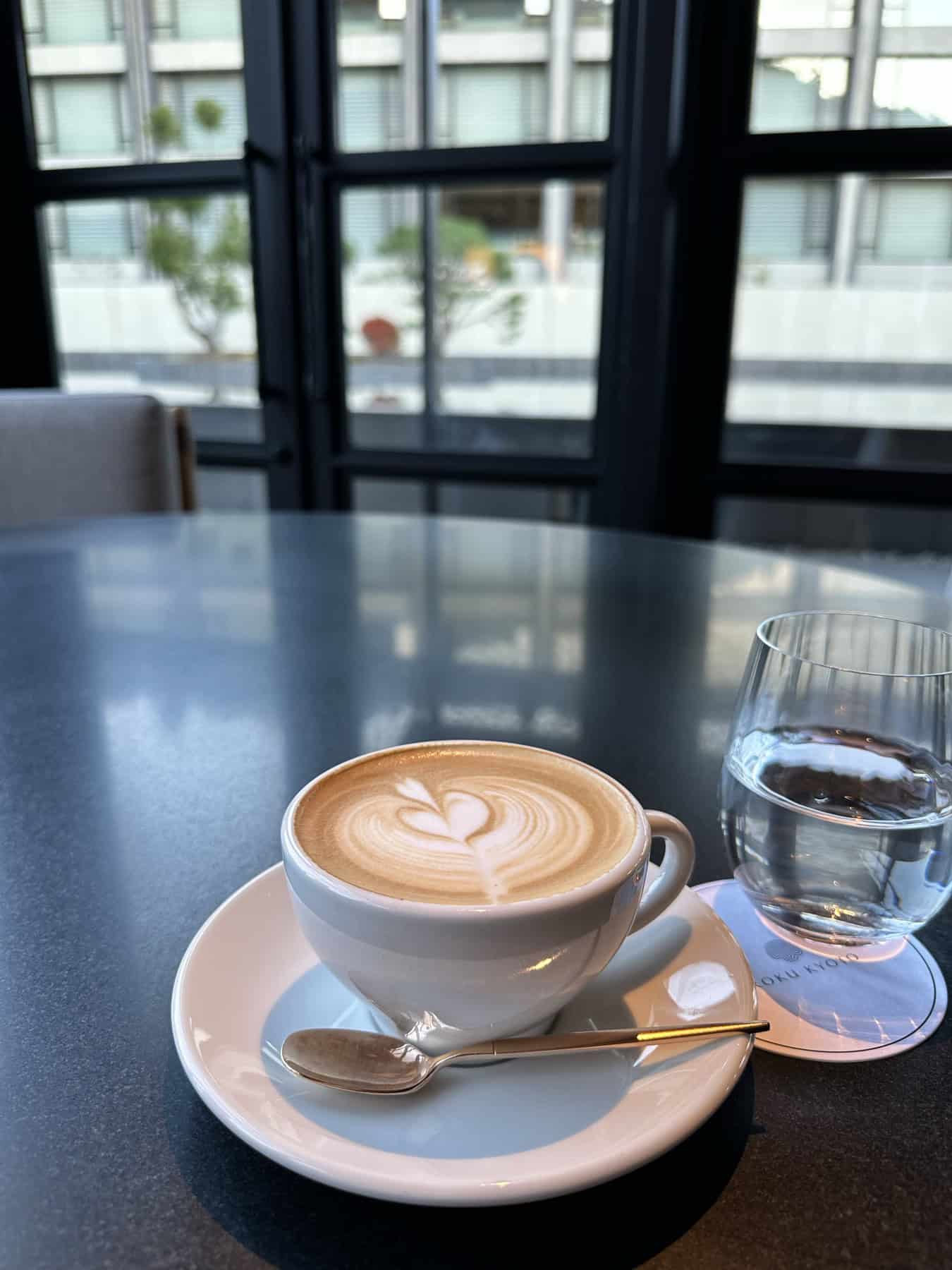
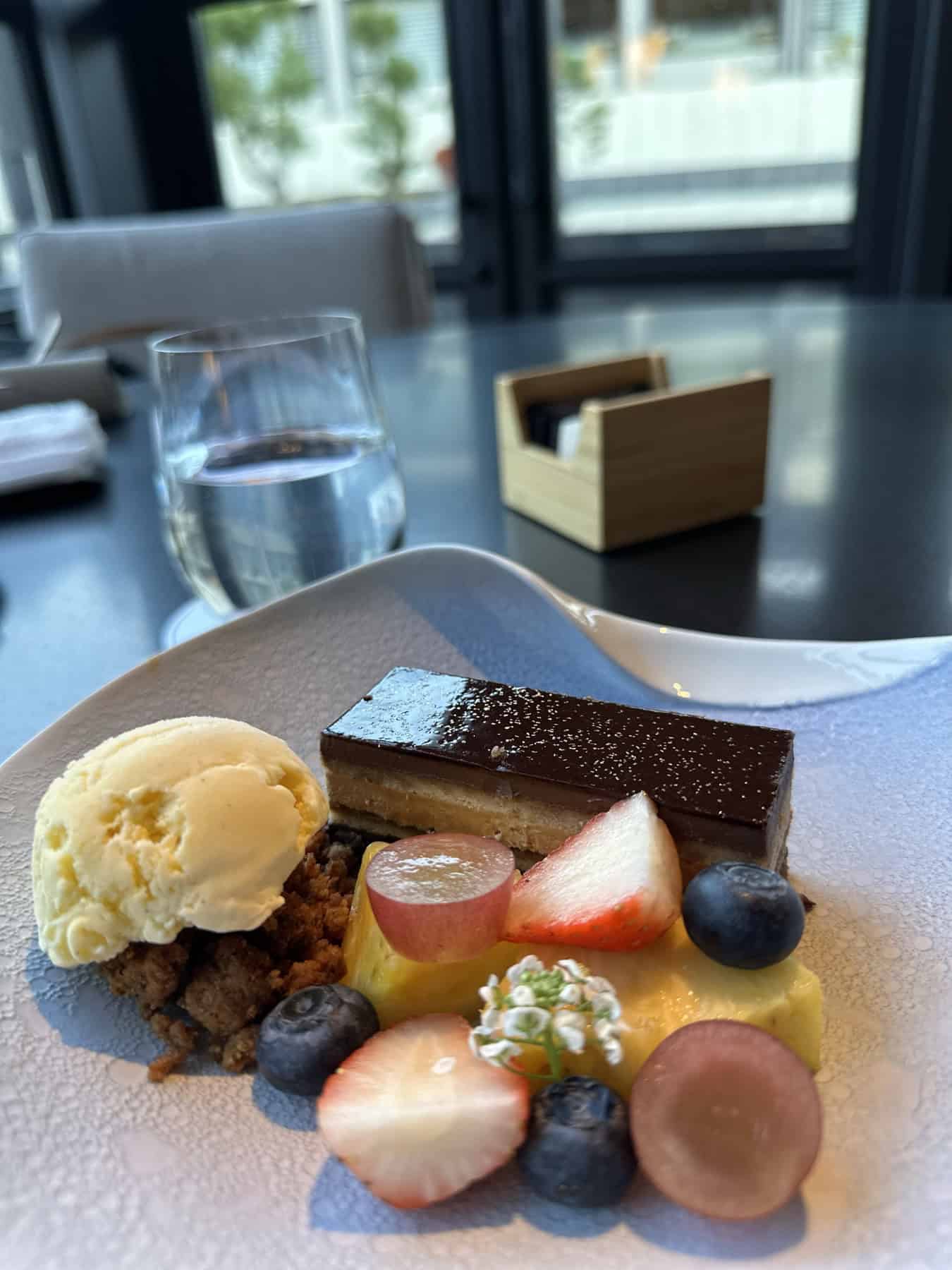
Delicious cake and coffee in a quiet space, along with the excitement of the stay ahead. It never felt like "waiting" at all; it was simply a lovely moment. Turning moments like this into a pleasant experience is, I think, what a true luxury hotel does well.
The Room (Room 424): Inspired by Karakami Paper
Using my free night certificate, I had originally booked a Deluxe Room (twin beds, about 50 m²). It is a standard rectangular layout, but 50 m² is plenty of space to fully relax. It is the entry-level category at this hotel, yet because the hotel itself is so luxurious, it never feels like a "basic" room.
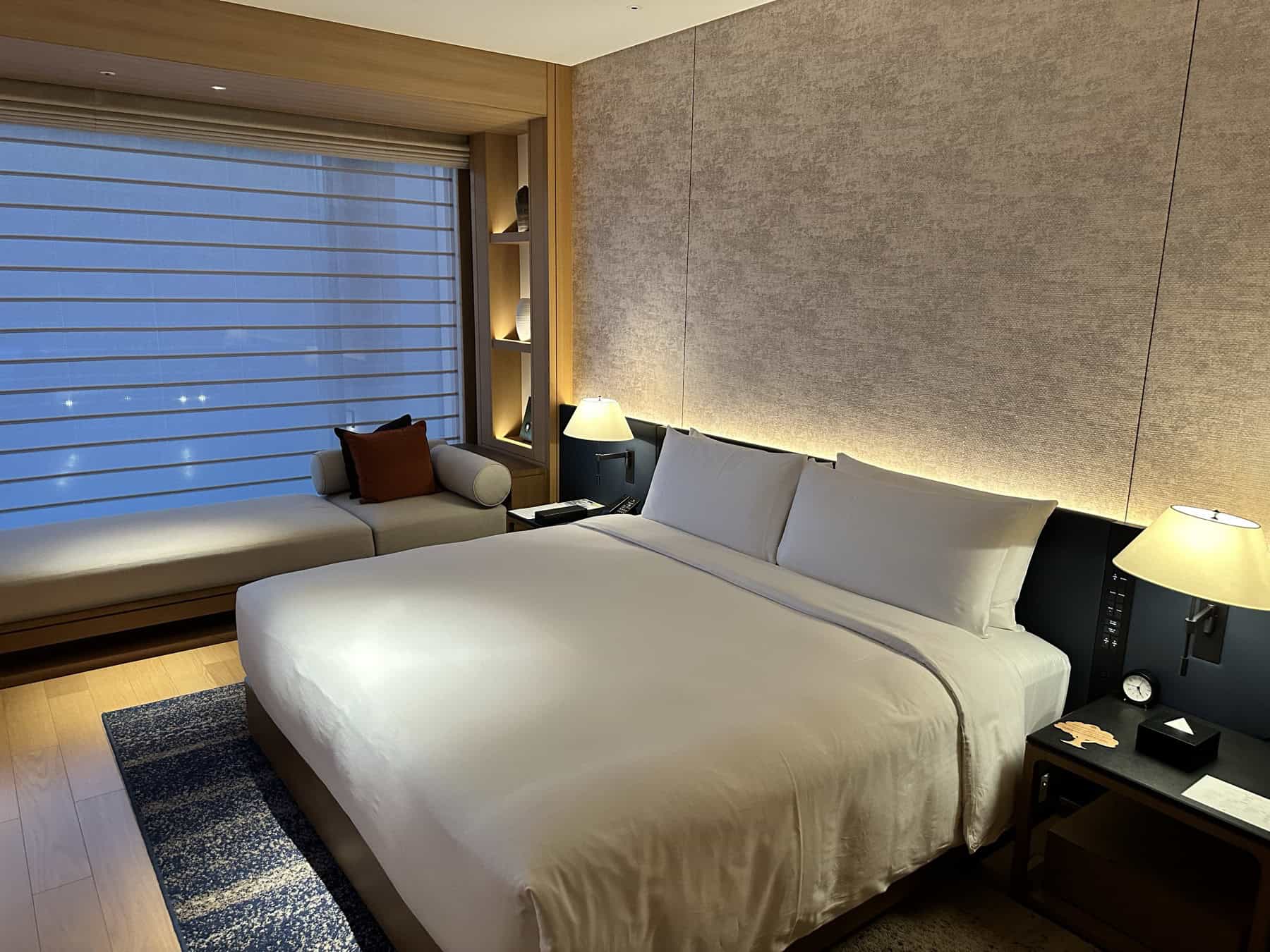
On the day, however, the bed type changed from twin to king due to availability, and I was kindly upgraded to a Premier Deluxe Room (king bed) on the top floor. My Hilton status is Diamond. I am truly grateful for their thoughtfulness. Finished in calm tones of wood and washi paper, this is a room that speaks through texture rather than flash.
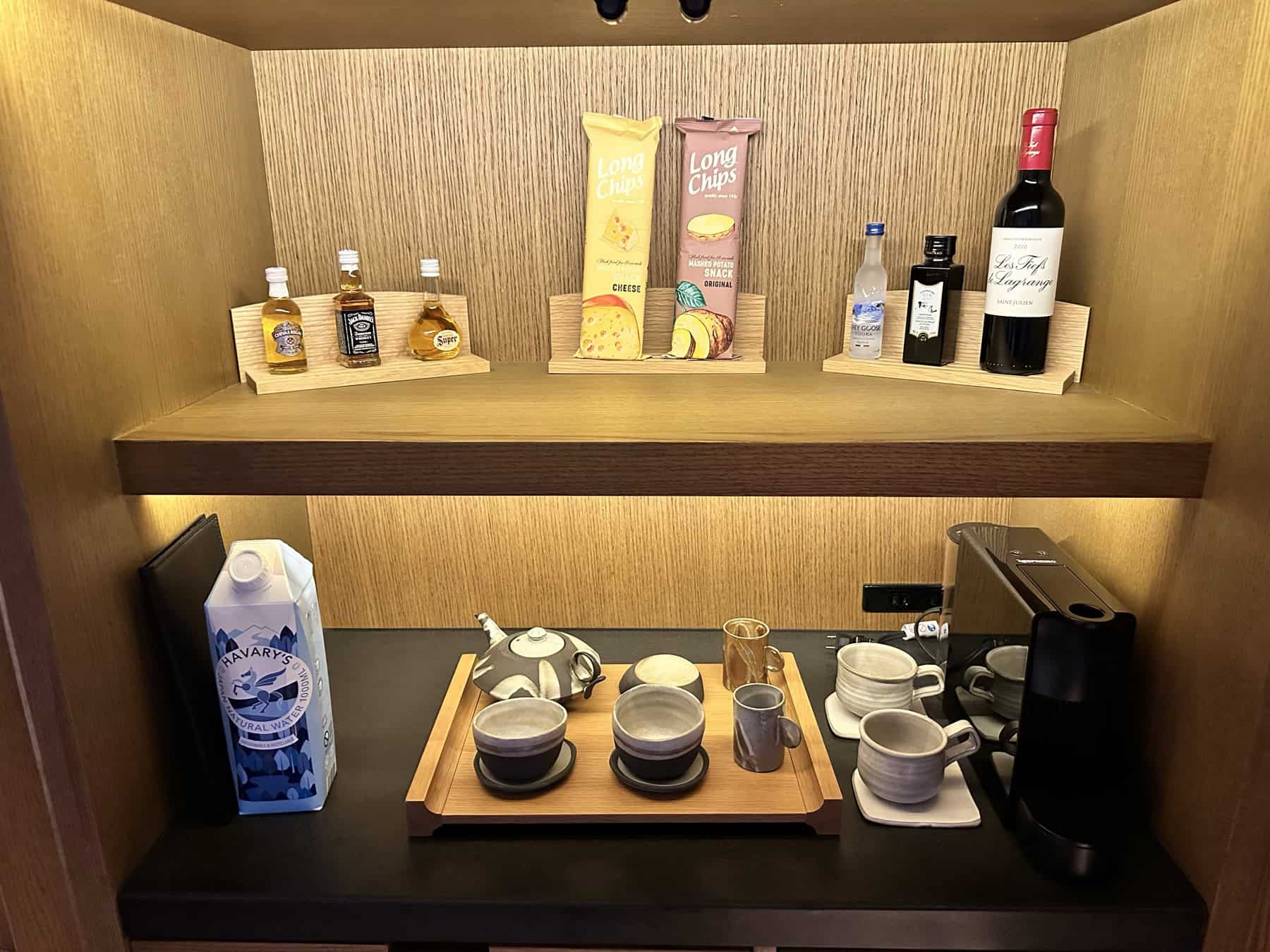
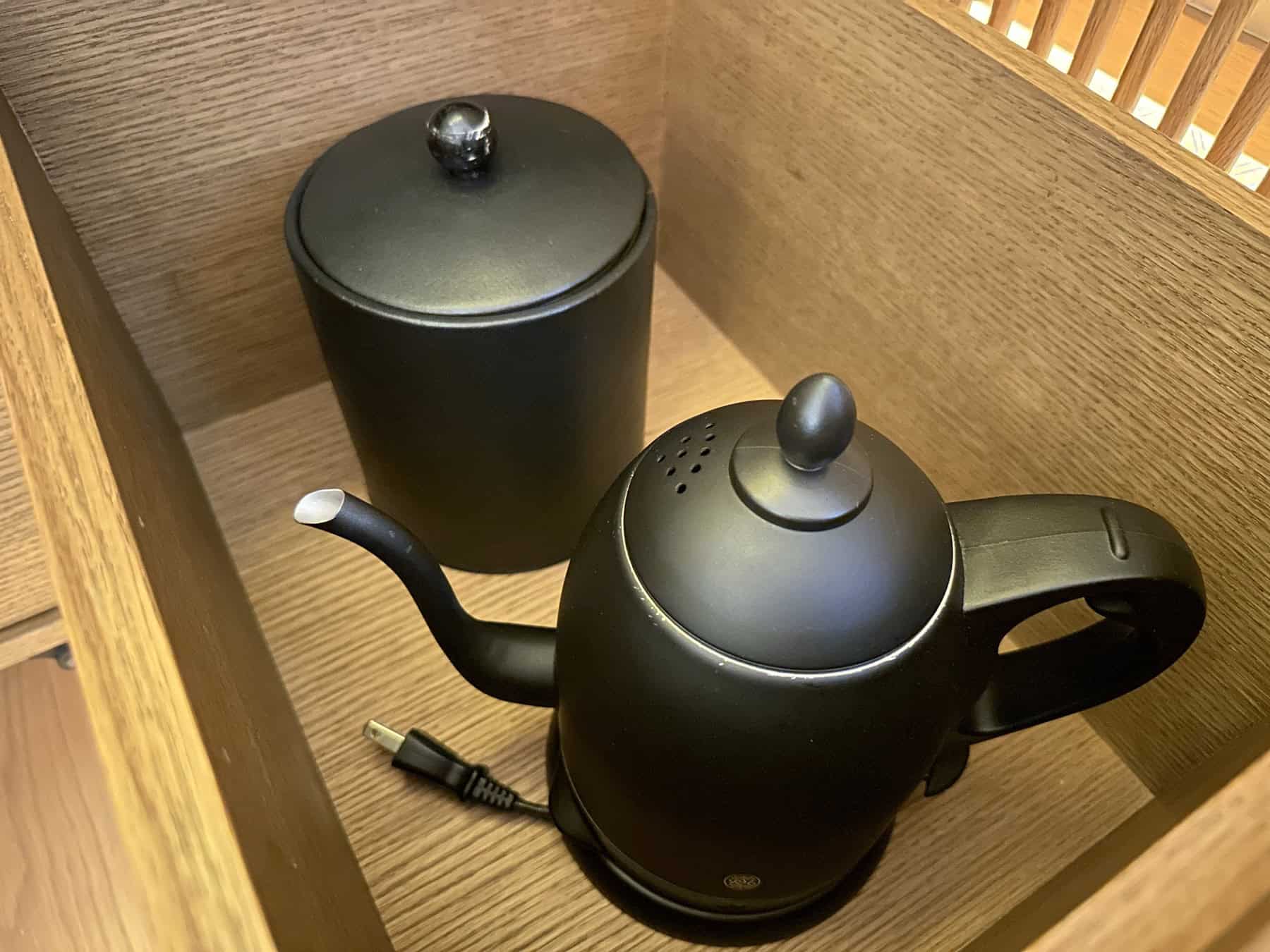
The minibar area was impressively thought out. A Nespresso machine, tea set and snacks are neatly arranged, and the drawers hold cutlery and glasses. What caught my eye most was the black cast-iron kettle (tetsubin) for boiling water. Every detail is unified in a Japanese style of luxury.
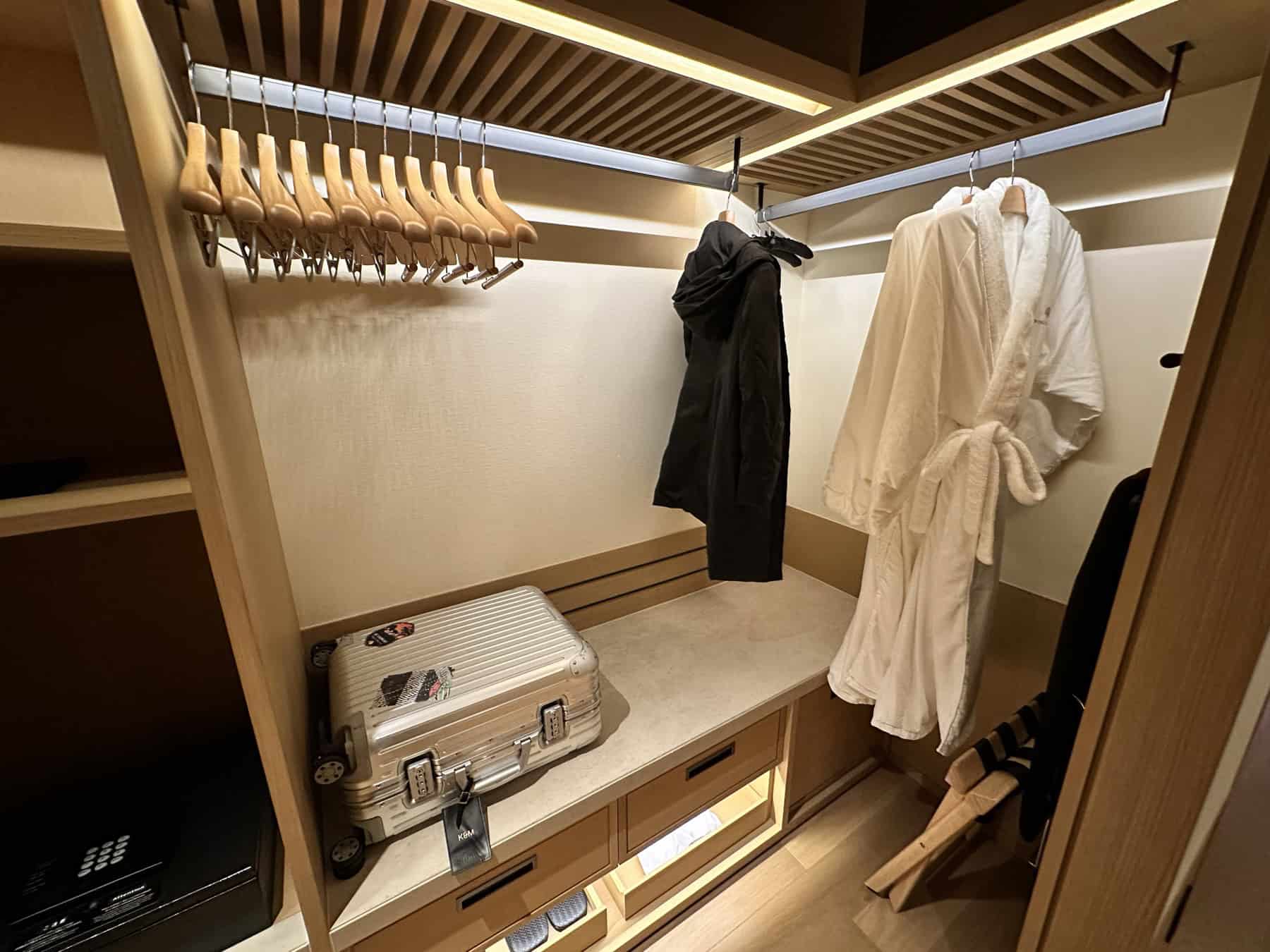
The closet is also spacious, with room to open a suitcase. There are plenty of hangers and space, so even in winter with bulky coats and extra luggage, you should have no trouble.
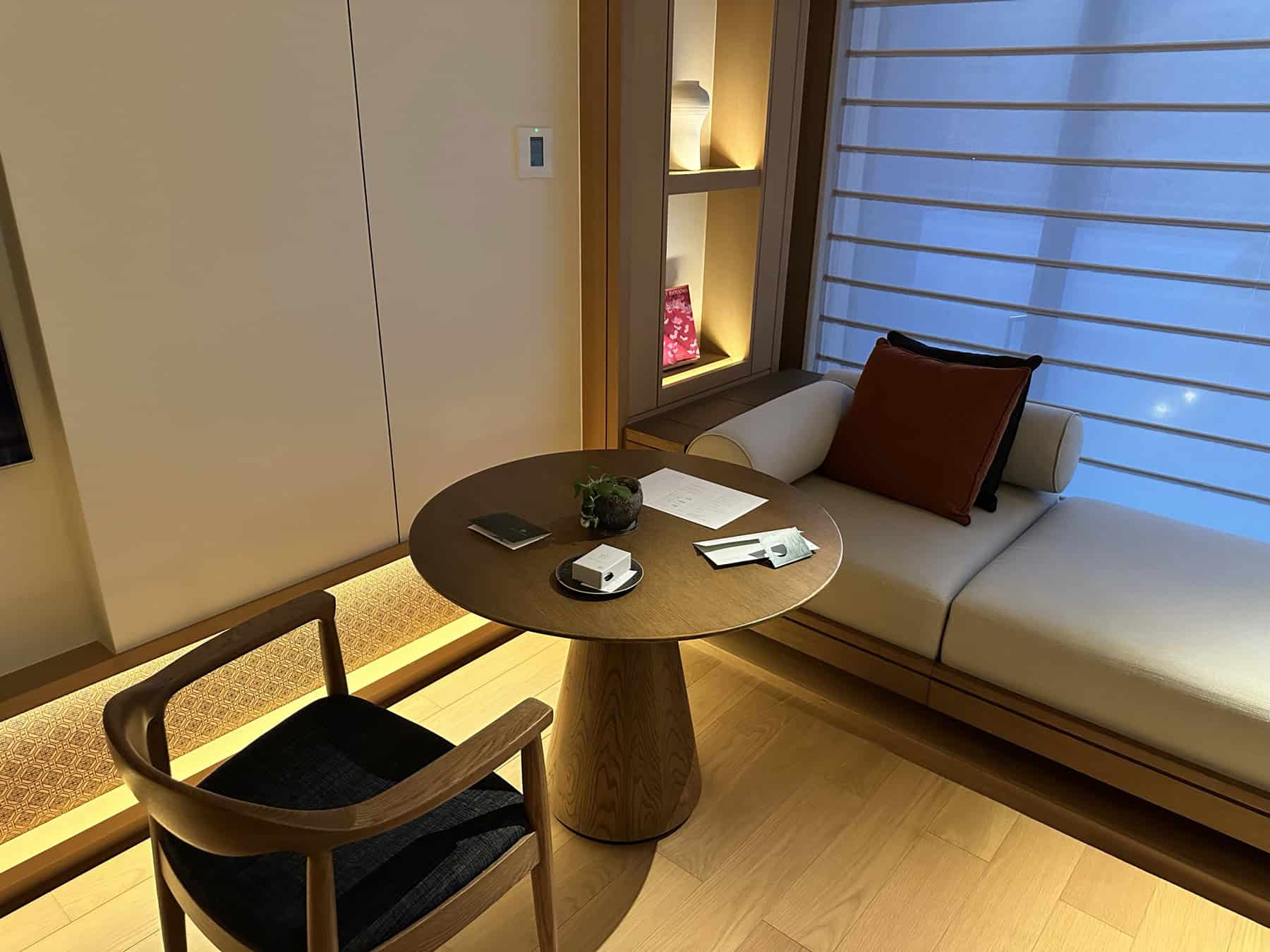
Above all, the real luxury is outside the window. The Takao hills in full autumn color and the reflecting pool spread out like a painting, right from your room. There is a couch by the window where you can sit and gaze at Kyoto's mountains for as long as you like.
Room Details
| Booked | Deluxe Room (twin, about 50 m²) → upgraded on arrival |
| Actual room | Premier Deluxe Room (king bed) / Room 424, 4th floor (top floor) |
| Status | Hilton Honors Diamond |
| Theme material | Karakami paper |
| View | Takao hills and reflecting pool (autumn leaves) |
| Amenities | Nespresso / iron kettle and tea set / minibar / HDMI, USB and AC power panel |
Bathroom and Amenities: Marble Tub and Rain Shower
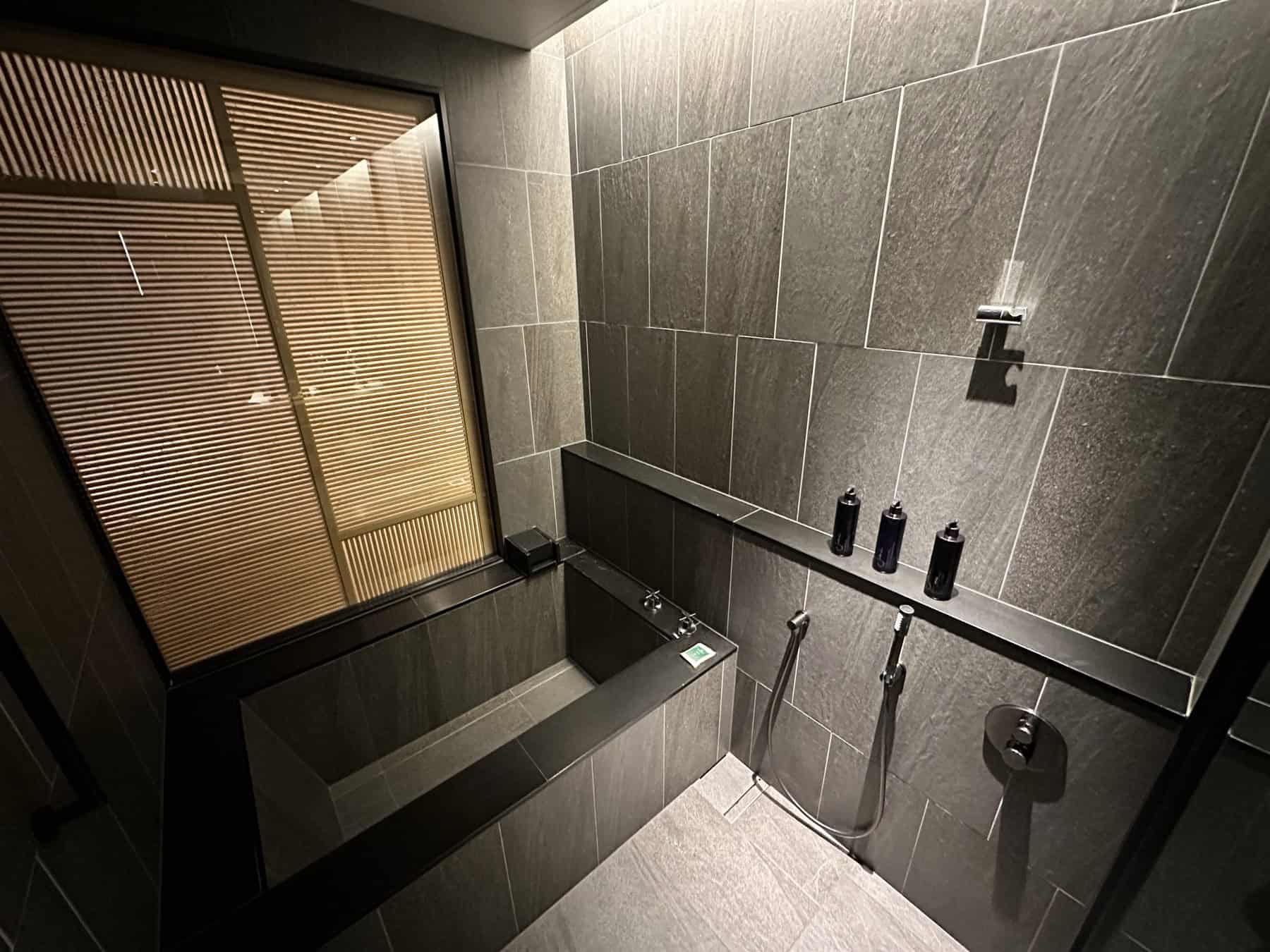
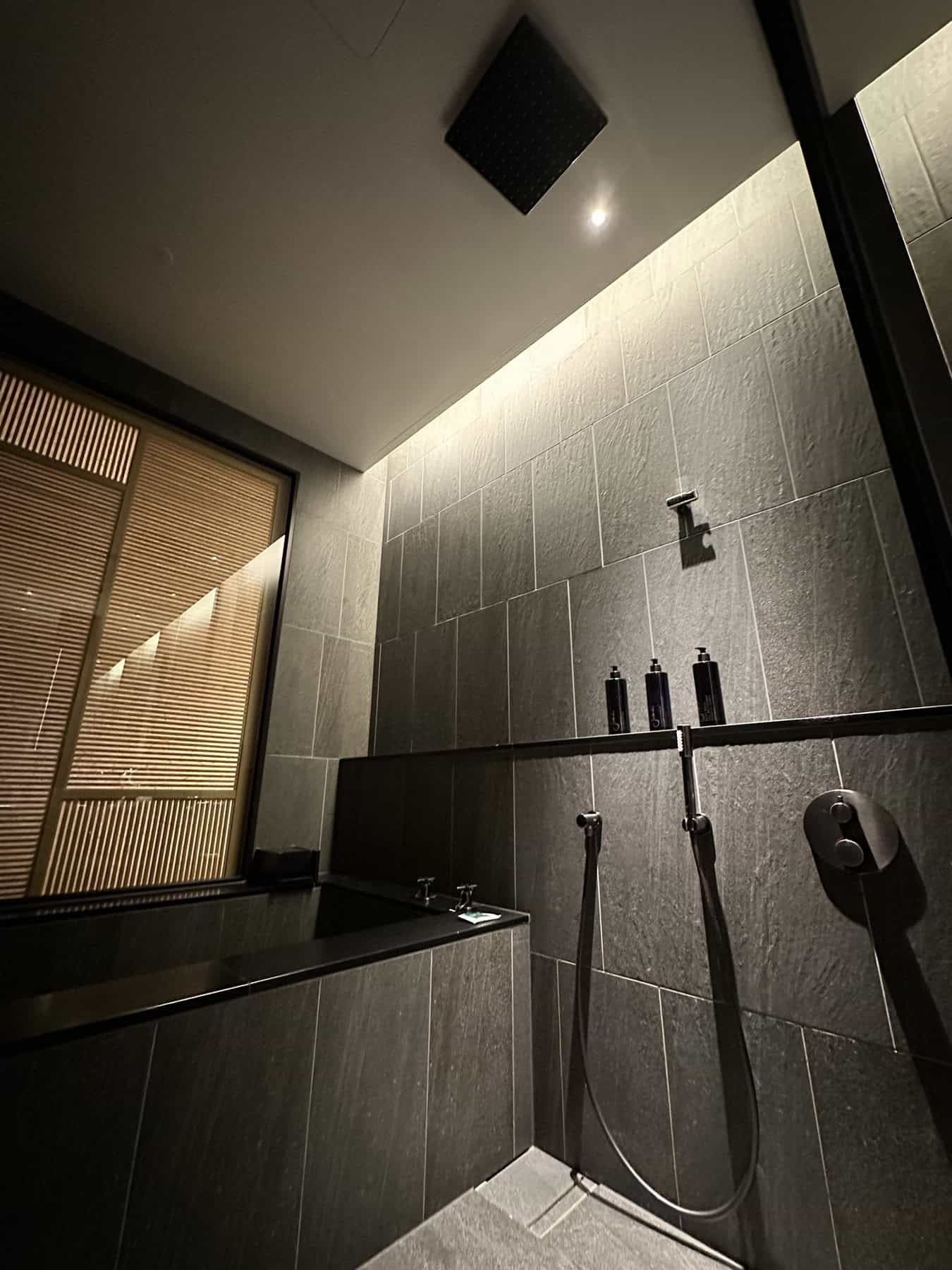
One of this hotel's biggest selling points, I think, is the luxury of its bathroom. Finished in dark-toned tiles and stone, it has a calm character all its own, unlike either a ryokan or a city hotel.
Bathroom Highlights
- Bathtub: big enough to stretch your legs, and made of marble for an extra touch of class
- Rain shower: overhead, the hallmark of a luxury hotel (at least in my book)
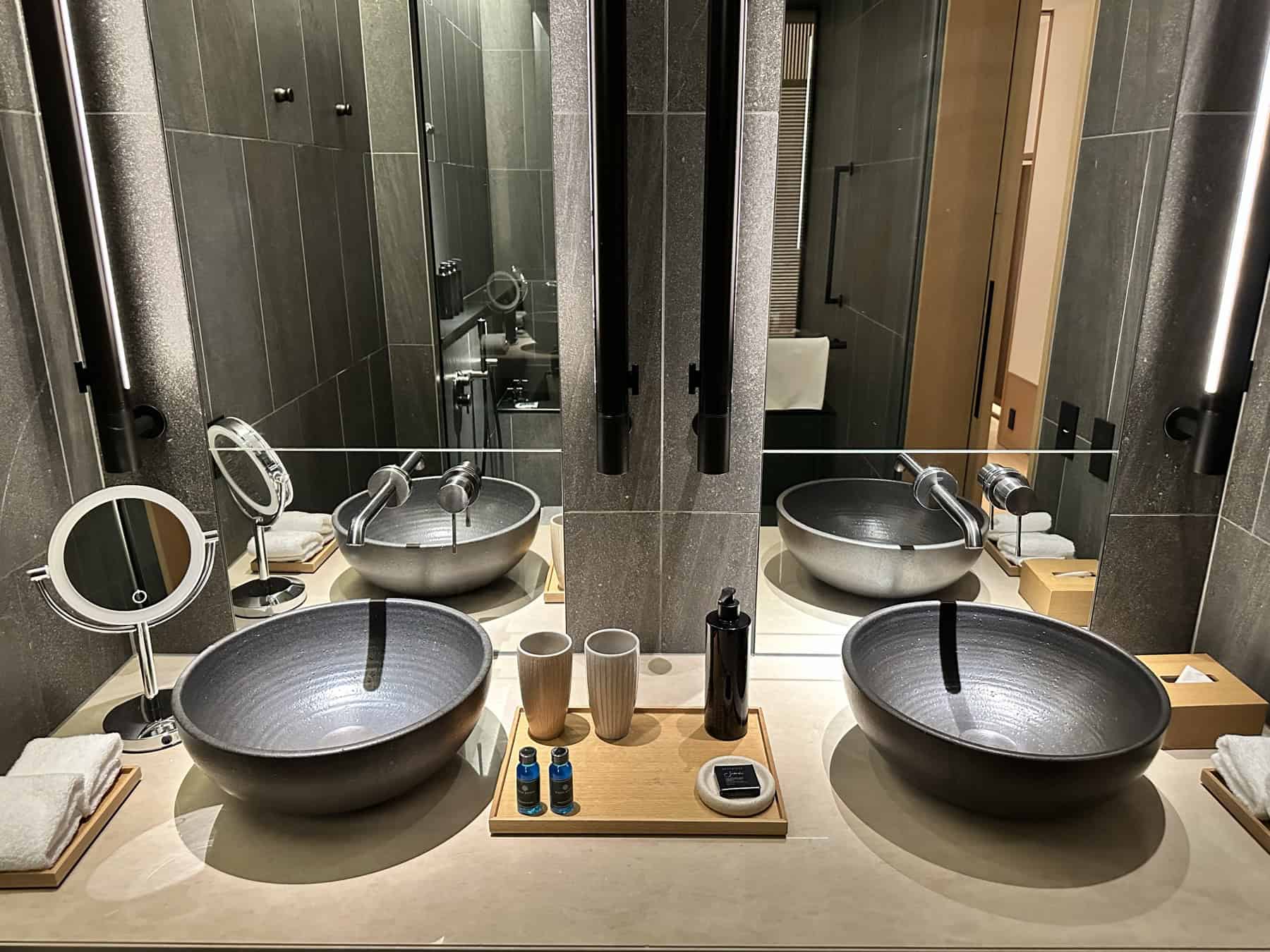
- Vanity: double sinks, a huge mirror and a magnifying mirror. Two people can get ready side by side with no squeeze
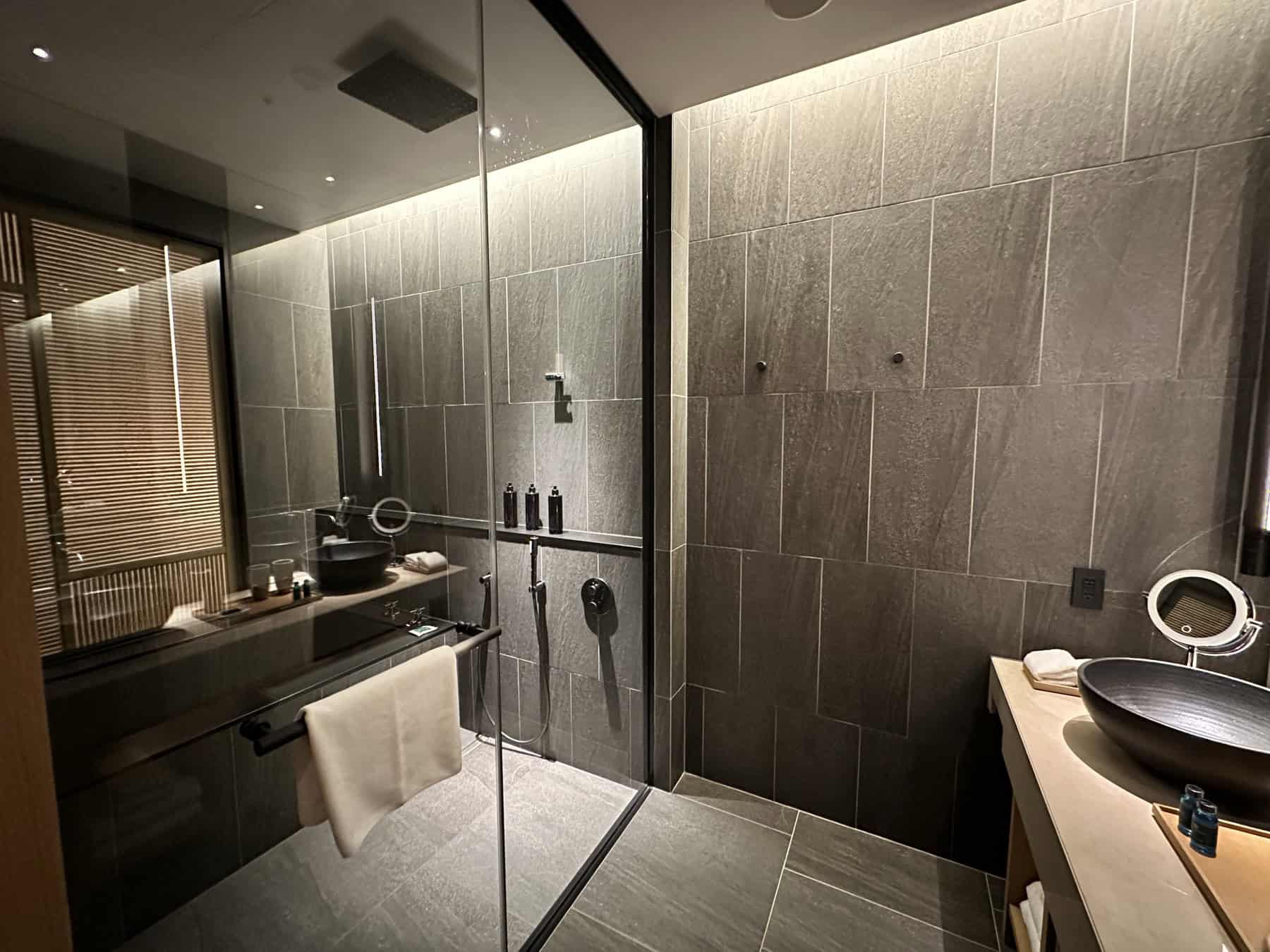
The vanity has double sinks and plenty of space. The mirror is huge, and there is a magnifying mirror too. The basins, which look as if they were carved from stone, are striking, and two people can get ready side by side without feeling cramped.
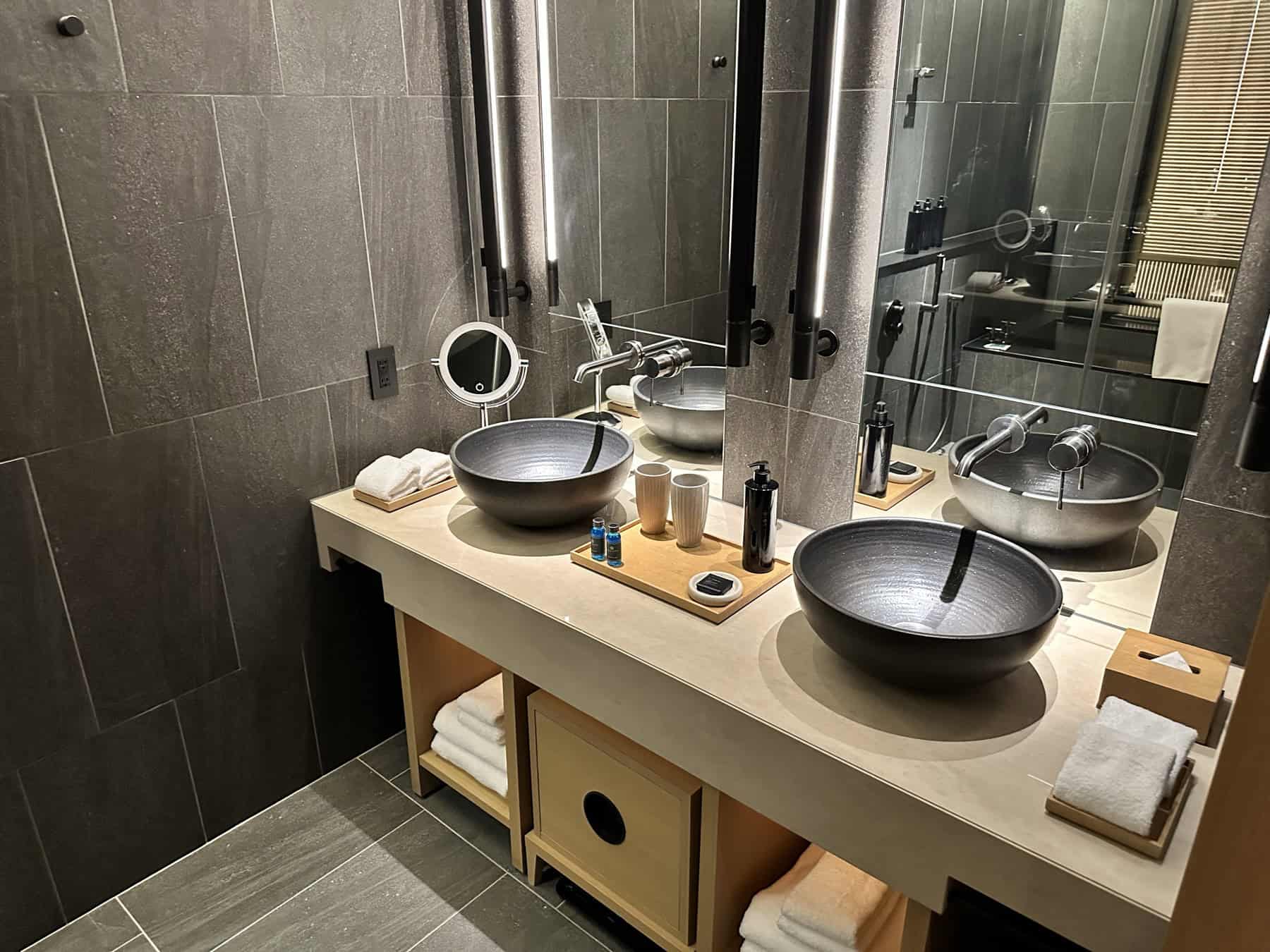
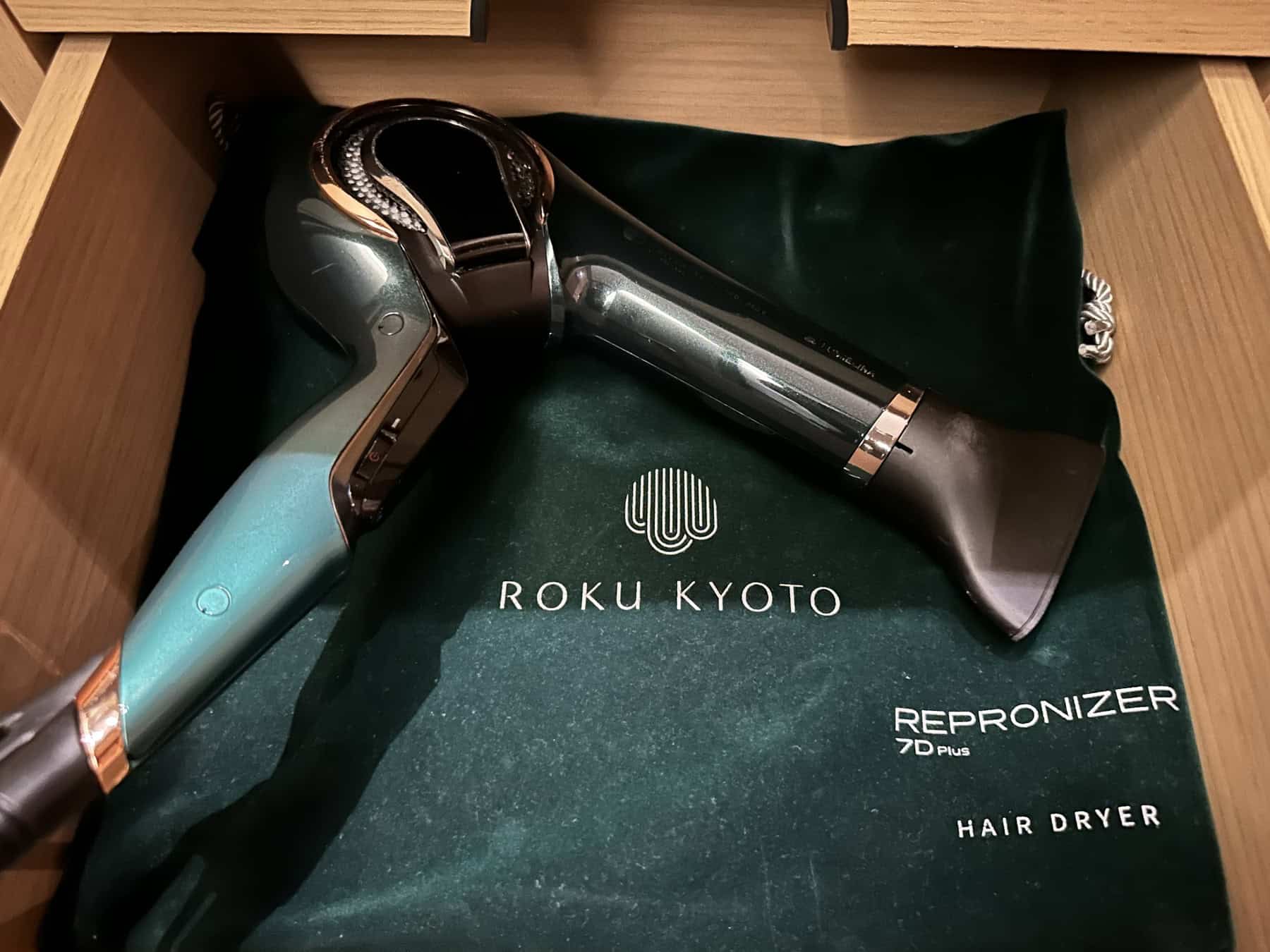
The bath amenities are by Sodashi, a natural skincare brand from Australia known for its plant-based ingredients and essential oils, and they felt wonderful to use. The hair dryer is the REPRONIZER by Lumielina, kept in a drawstring bag with the ROKU KYOTO logo. The hospitality reaches every detail.
THE ROKU SPA: Natural Hot Spring and Thermal Pool
A major draw of ROKU KYOTO is its natural hot spring (onsen) and thermal pool, which let you enjoy a stay "with hot water" that city hotels can't offer. The spa's theme material is ceramics. At night, the illuminated reflecting pool takes on a serene look completely different from the daytime.
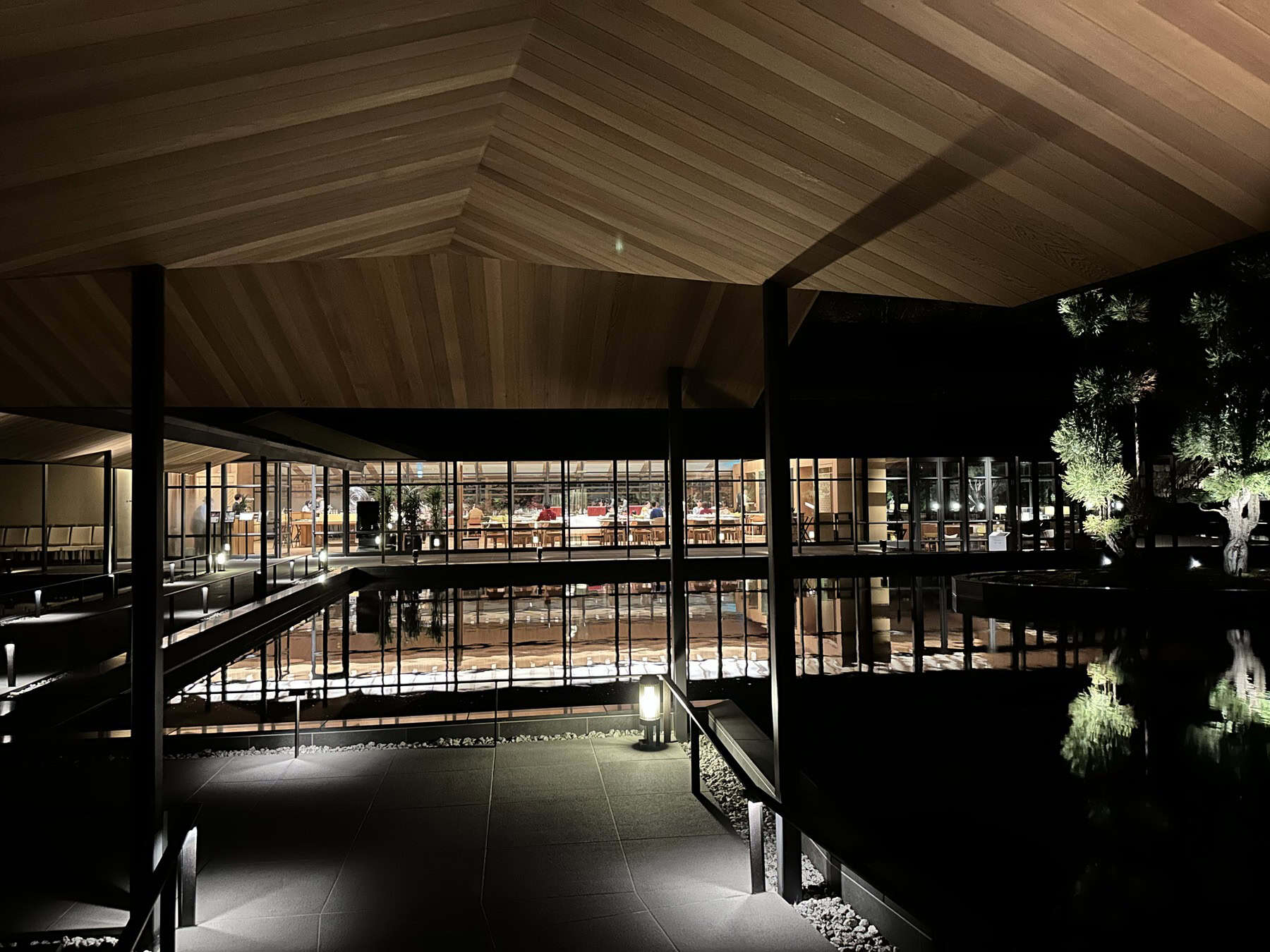
...That said, this time I didn't use the hot spring, the gym or the pool. Time in the room was just too comfortable, and I kept putting it off. Next time, I would love to watch the autumn leaves from the morning onsen. I'll leave that as homework for my next visit.
Restaurant TENJIN: Inspired by Bamboo
For dinner, I had the "ROKU (麓)" course at the hotel's restaurant, TENJIN. The special evening begins with the table setting itself, laid with gold cutlery. The chef is Akira Taniguchi, and the course is rooted in the region, preparing Kyoto ingredients with French techniques.
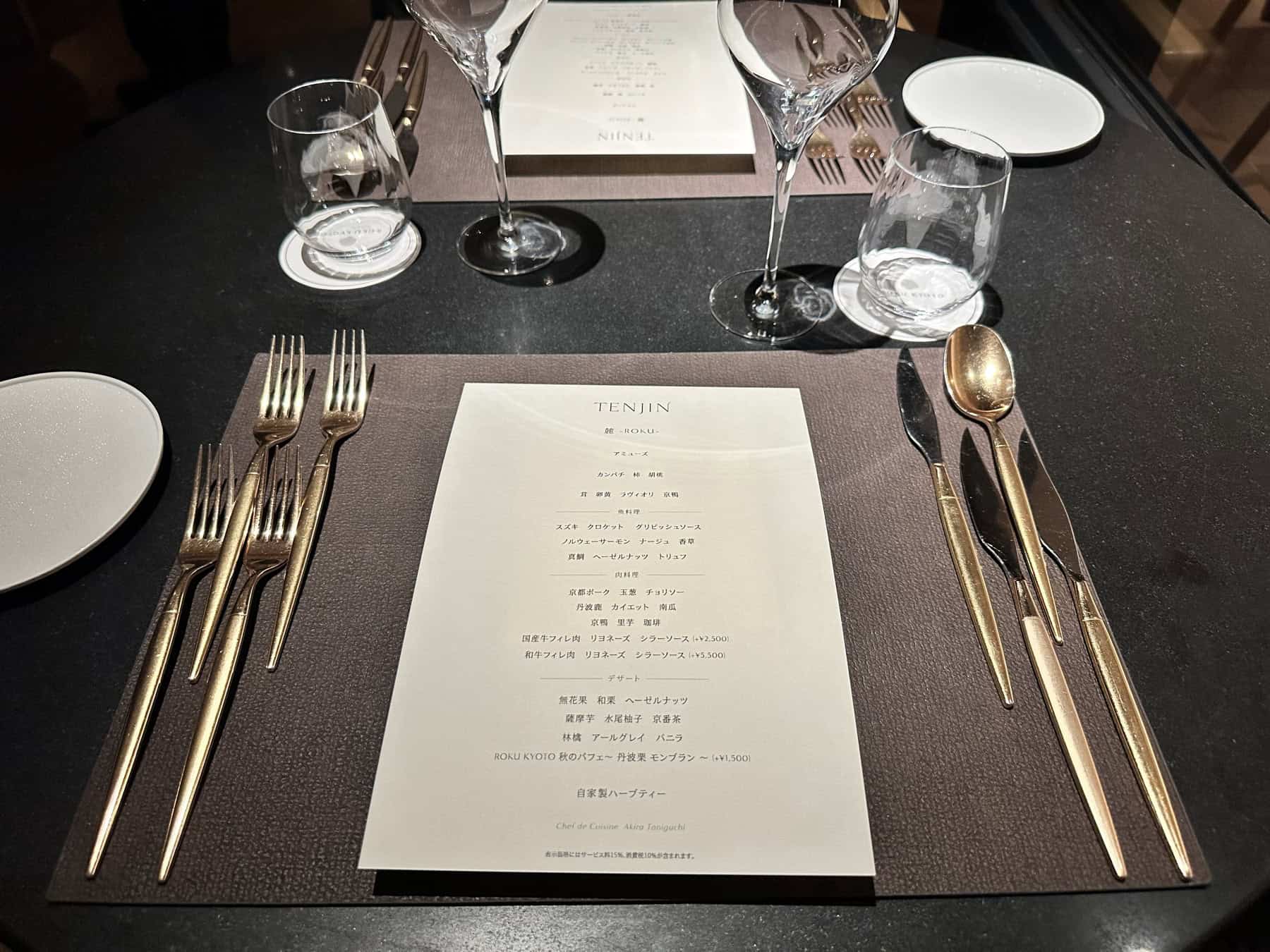
"ROKU" dinner course menu
| Course | Dishes |
|---|---|
| Amuse-bouche | — |
| Appetizer 1 | Amberjack / persimmon / walnut |
| Appetizer 2 | Mushrooms / egg yolk / ravioli / Kyoto duck |
| Fish (choose one) | Japanese sea bass / croquette / gribiche sauce · Norwegian salmon / nage / herbs · Sea bream / hazelnut / truffle |
| Meat (choose one) | Kyoto pork / onion / chorizo · Tamba venison / caillette / pumpkin · Kyoto duck / taro / coffee · (+¥2,500) Japanese beef fillet / lyonnaise / Syrah sauce · (+¥5,500) Wagyu fillet |
| Dessert (choose one) | Fig / Japanese chestnut / hazelnut · Sweet potato / Mizuo yuzu / Kyo-bancha tea · Apple / Earl Grey / vanilla · (+¥1,500) ROKU KYOTO autumn parfait with Tamba chestnut Mont Blanc |
| To finish | House-made herbal tea |
Prices shown include a 15% service charge and 10% consumption tax.
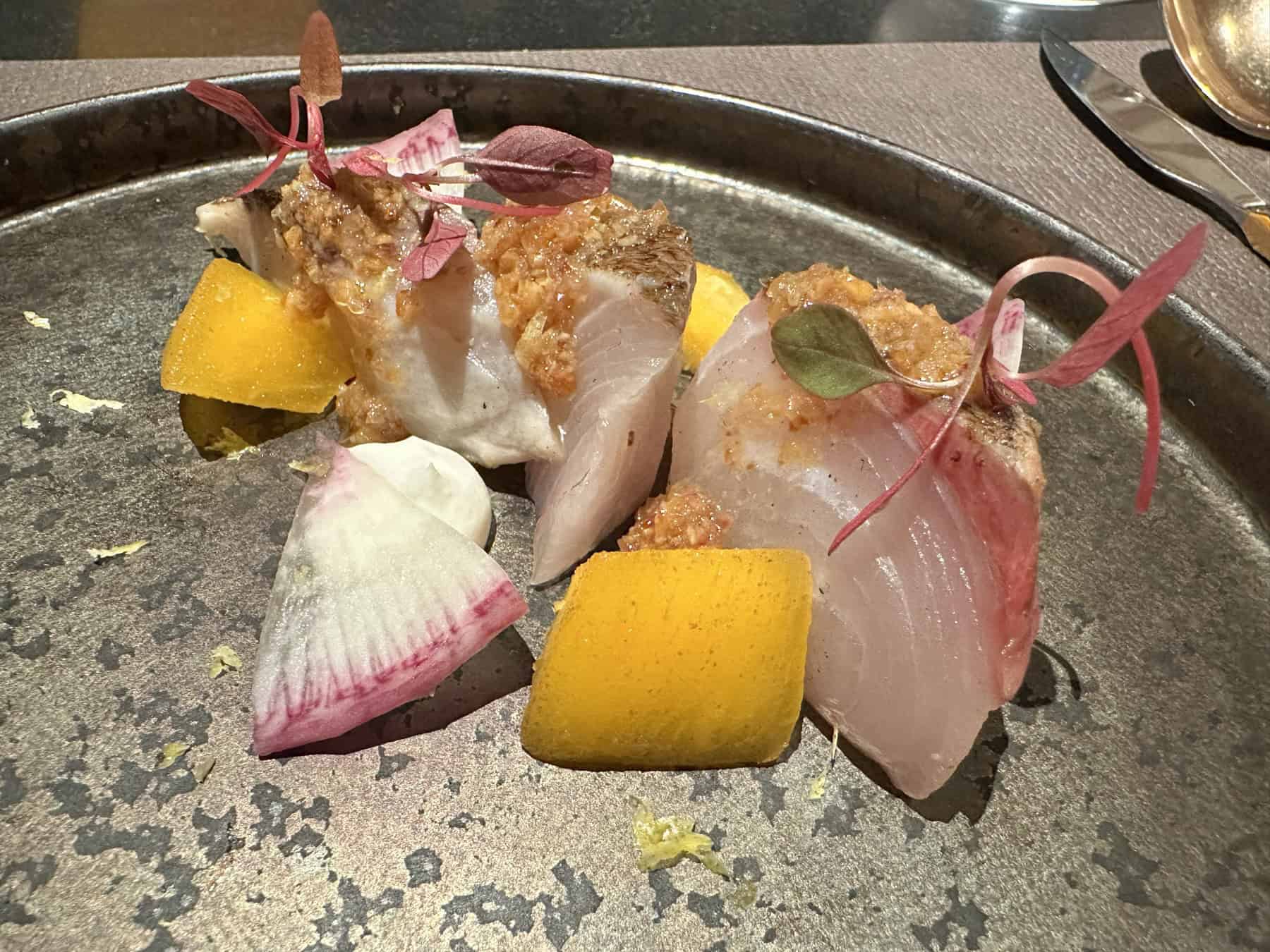
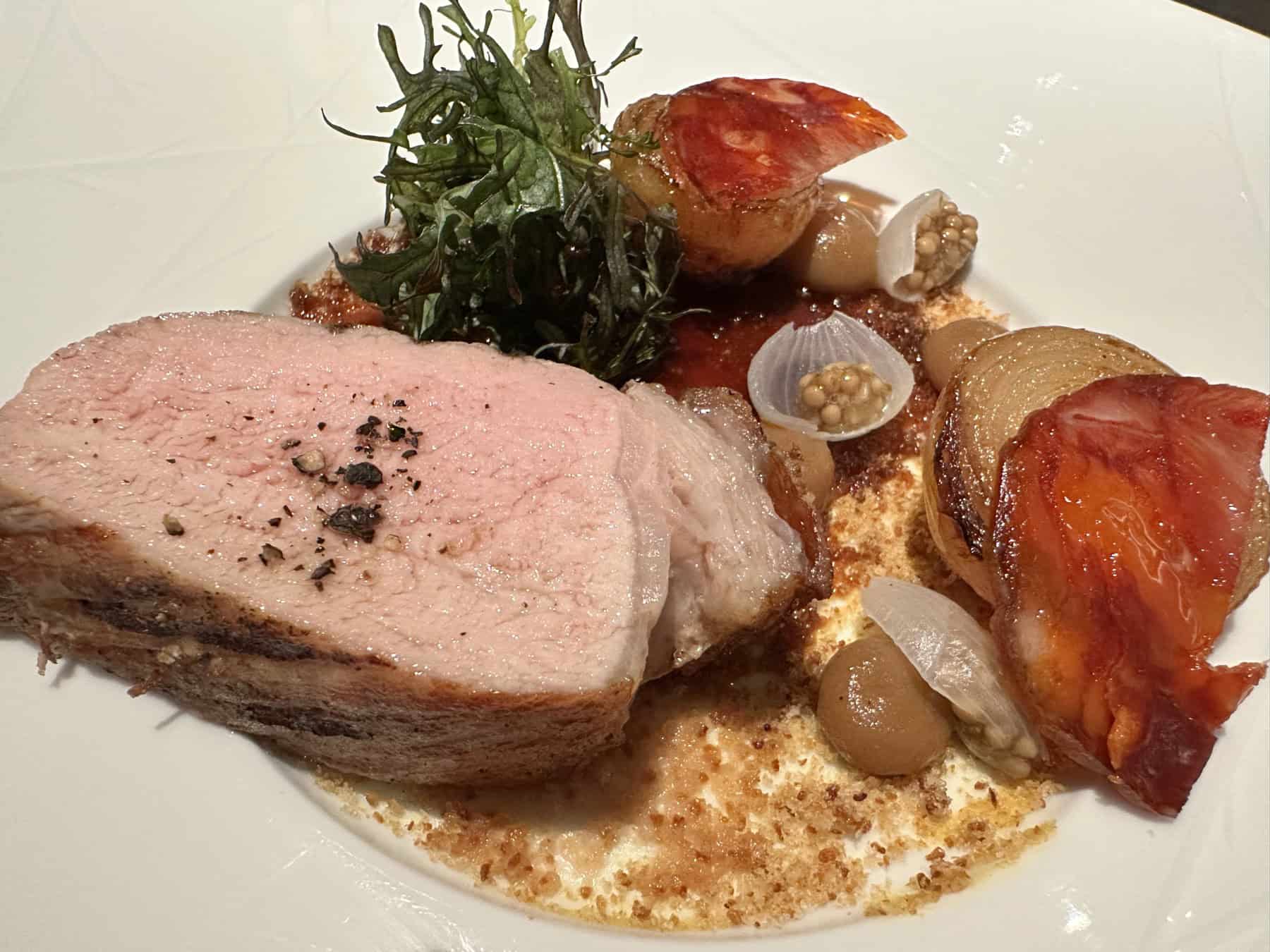
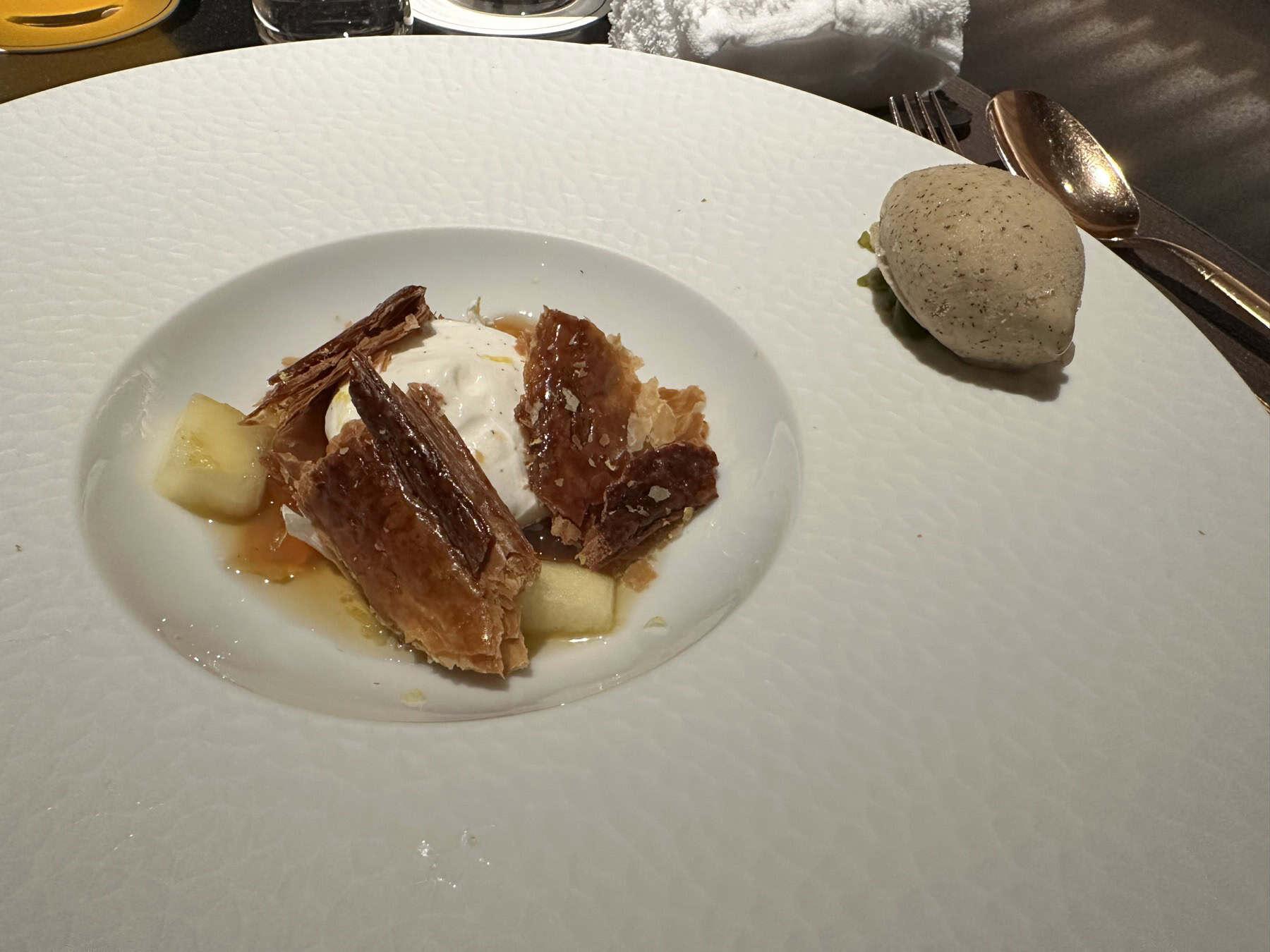
Kyoto pork, Tamba venison, Kyoto duck, Mizuo yuzu... it is a fun course where local ingredients take center stage in each dish. I'll admit I'm biased as a fish lover, but the sea bass was exceptional. Unlike an everyday meal just to fill you up, food enjoyed slowly in a stylish space makes for a truly fulfilling time. I skipped alcohol this time and chose sparkling water. Although it is a full course with many dishes, the quiet bamboo-themed space and the sound of the river kept me relaxed right to the end.
Breakfast: Kyoto Duck Rice Porridge in an Autumn-Leaf Dining Room
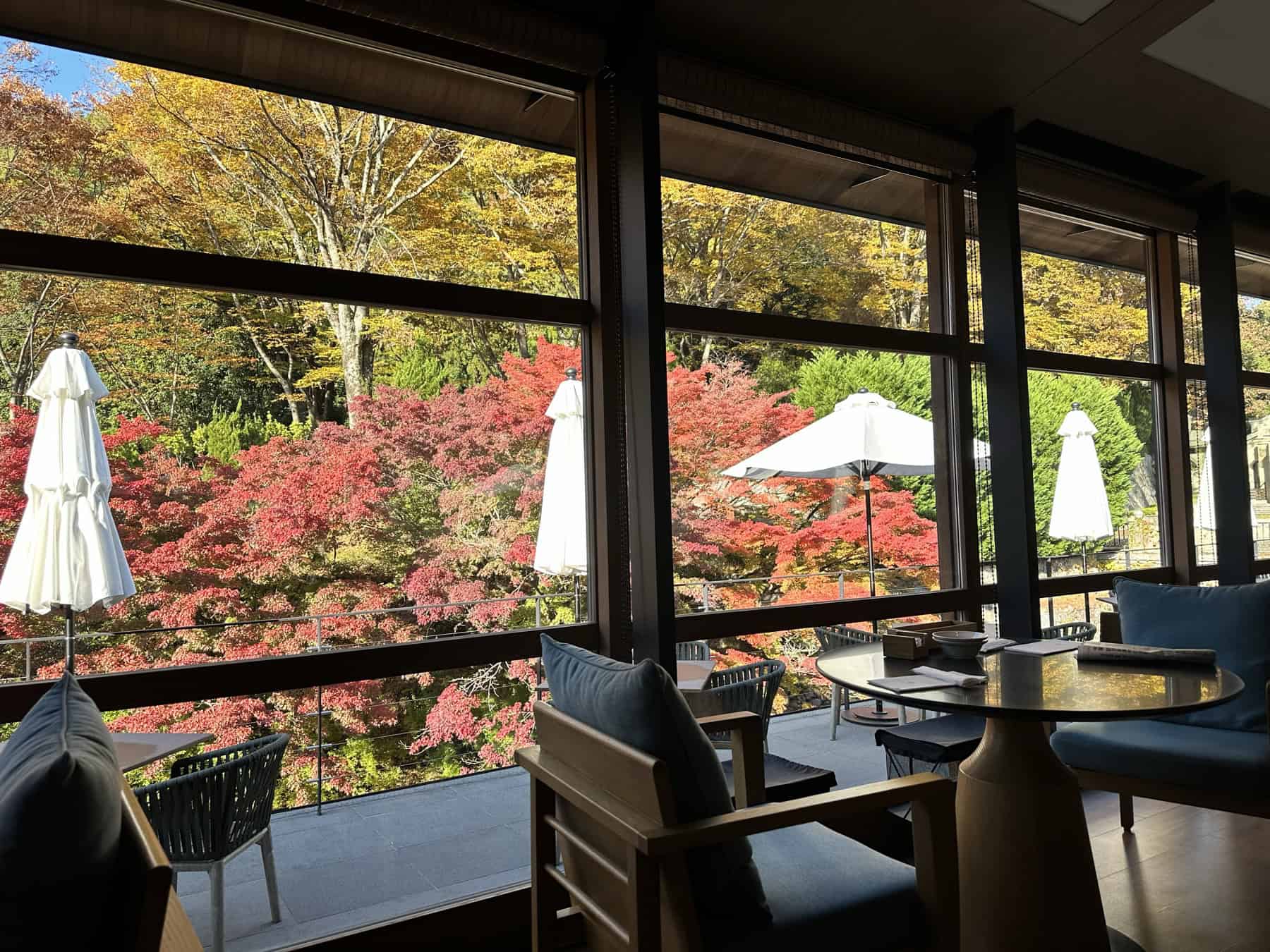
The next morning, the dining room's huge windows were filled with autumn leaves, and every seat felt like the best seat in the house. Breakfast is either the ROKU BREAKFAST (¥6,300) or a half buffet, and you choose one main dish from a list of Kyoto-style signatures.
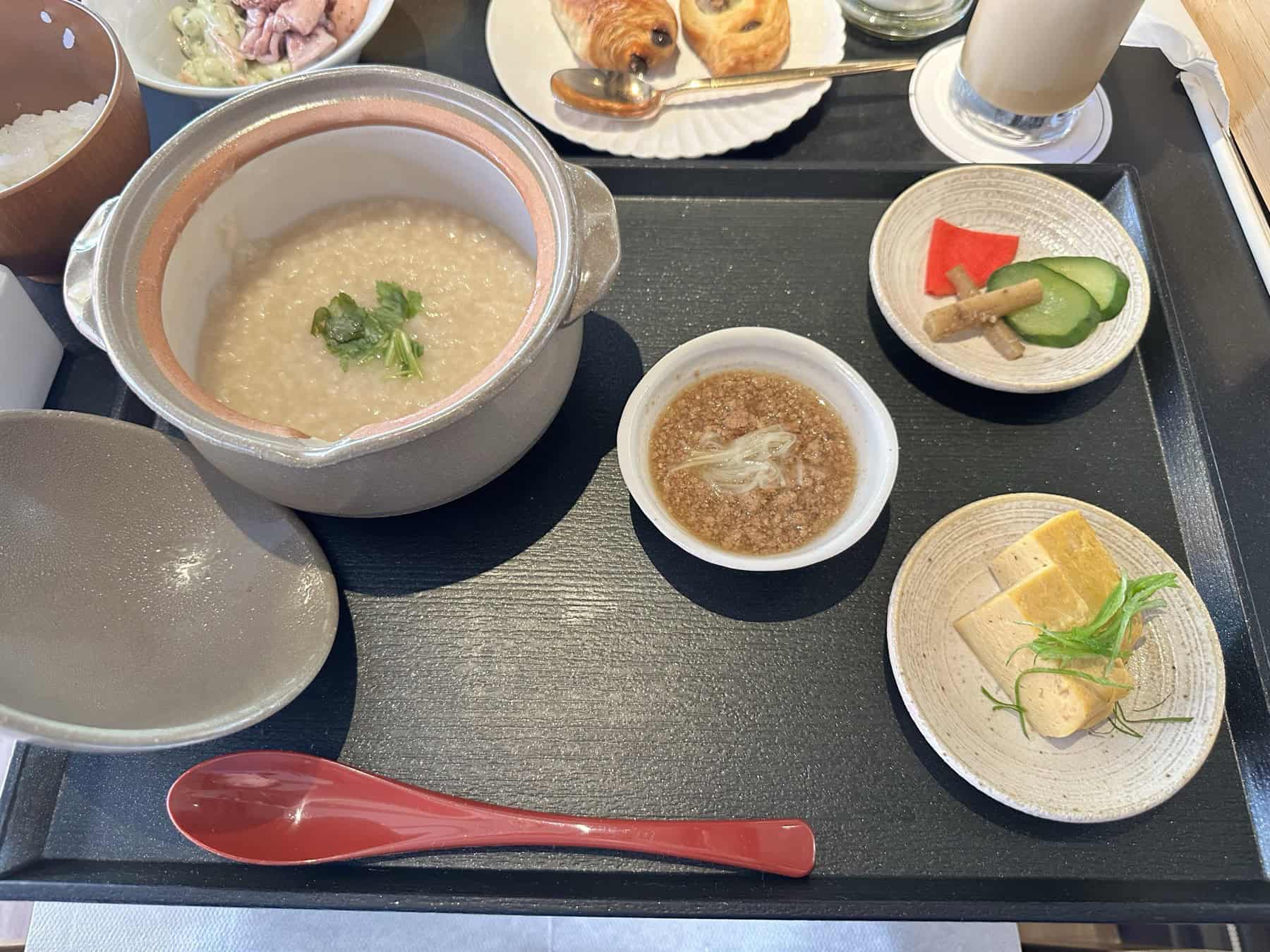
Main Dish Options (selection)
- ROKU Kyoto duck rice porridge: rolled omelet made with Kyoto duck eggs, Kyoto duck soboro sauce and house-made pickles (signature)
- ROKU original udon with yuba sauce: root vegetable sauce, fresh scooped yuba from Hanbey Fu, and Kujo green onion
- ROKU Select autumn omelet (pumpkin and spinach / bone-in sausage)
- Eggs Benedict with Tamba venison ragù (venison from Miyama, Kyoto)
- Fried eggs
My choice was the Kyoto duck rice porridge. Meals while traveling tend to lean toward junk food, so I wanted something gentle on the stomach. It turned out to be refined and delicious, and made me want to order along these lines again next time.
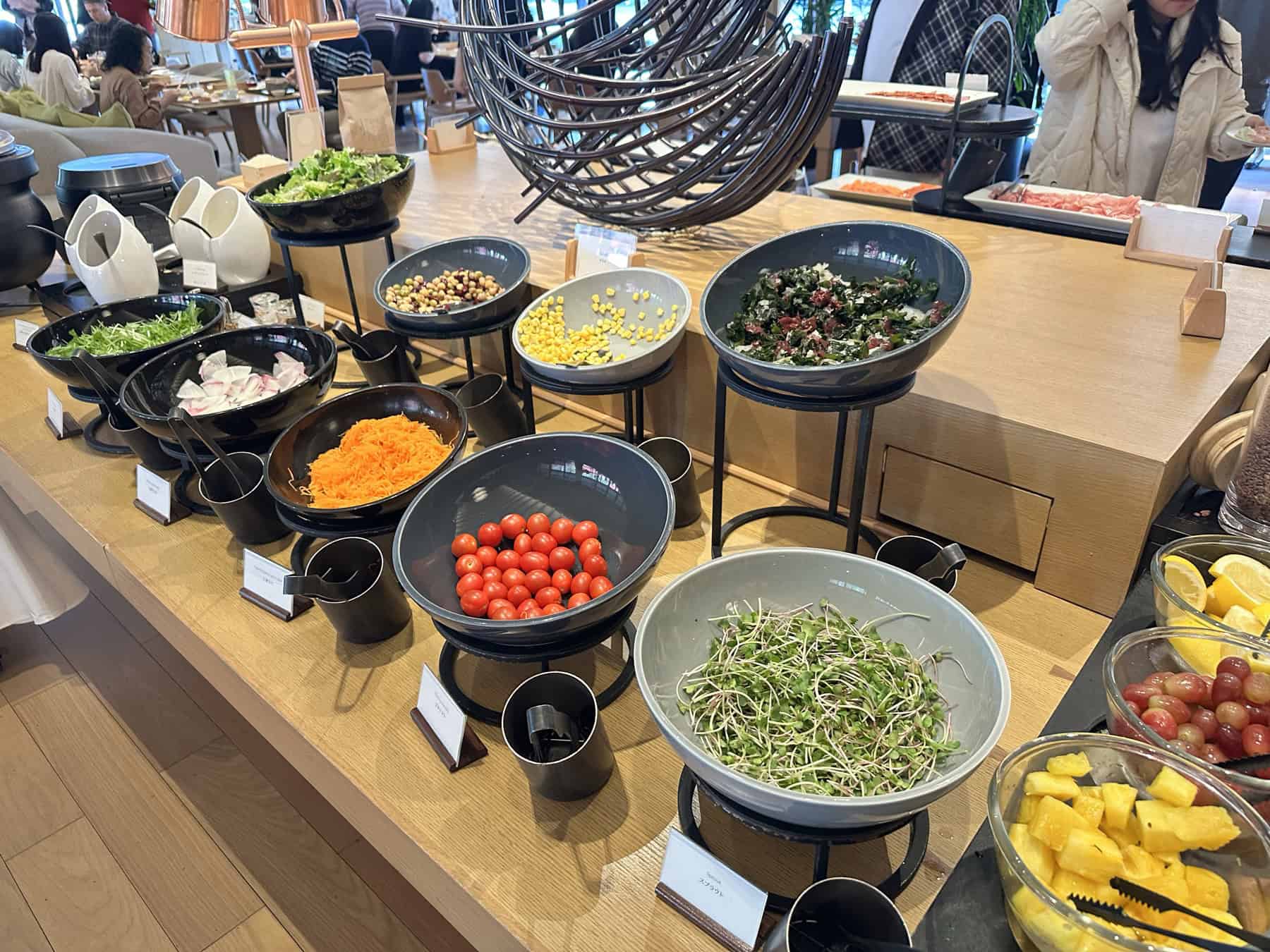
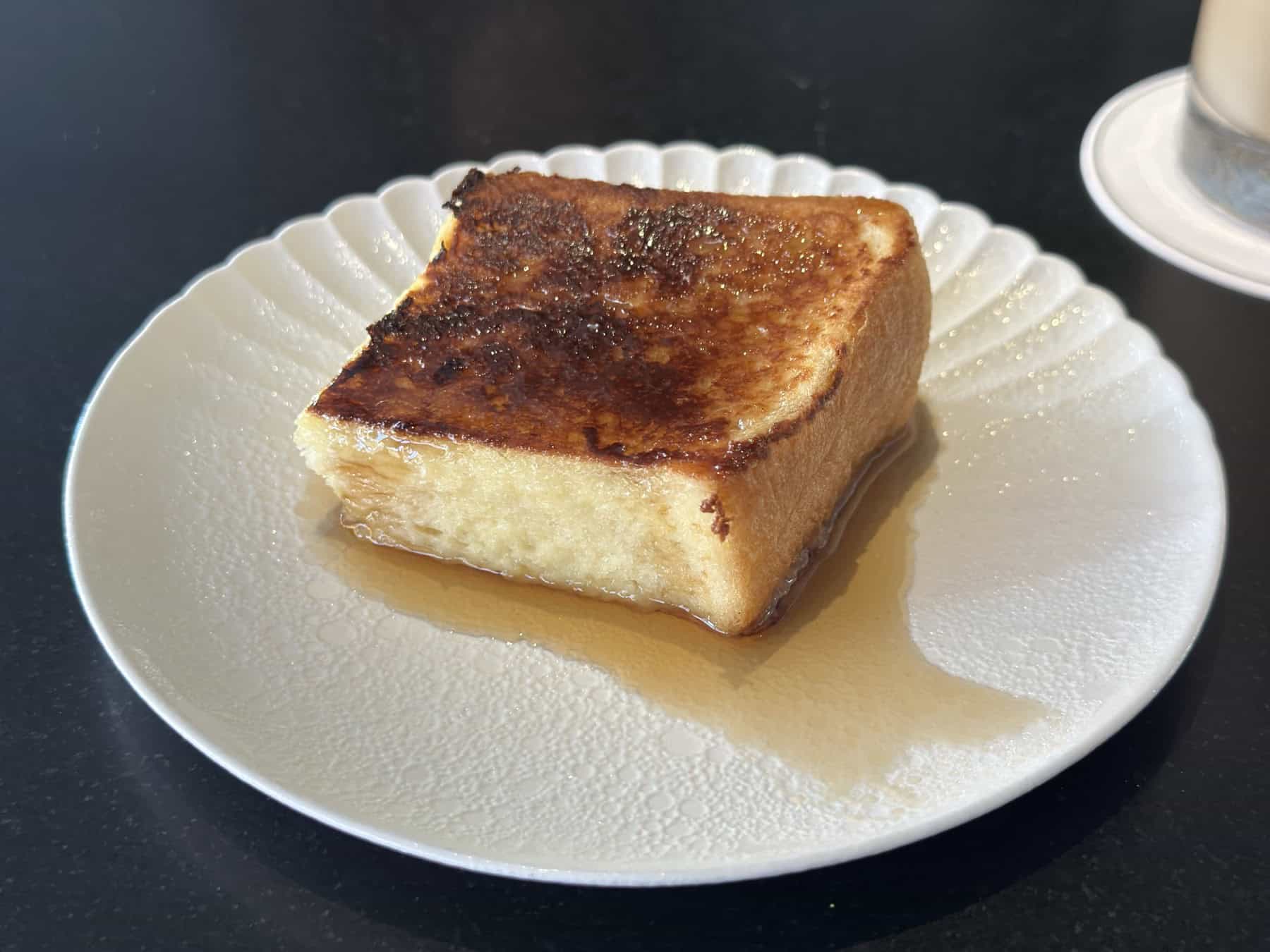
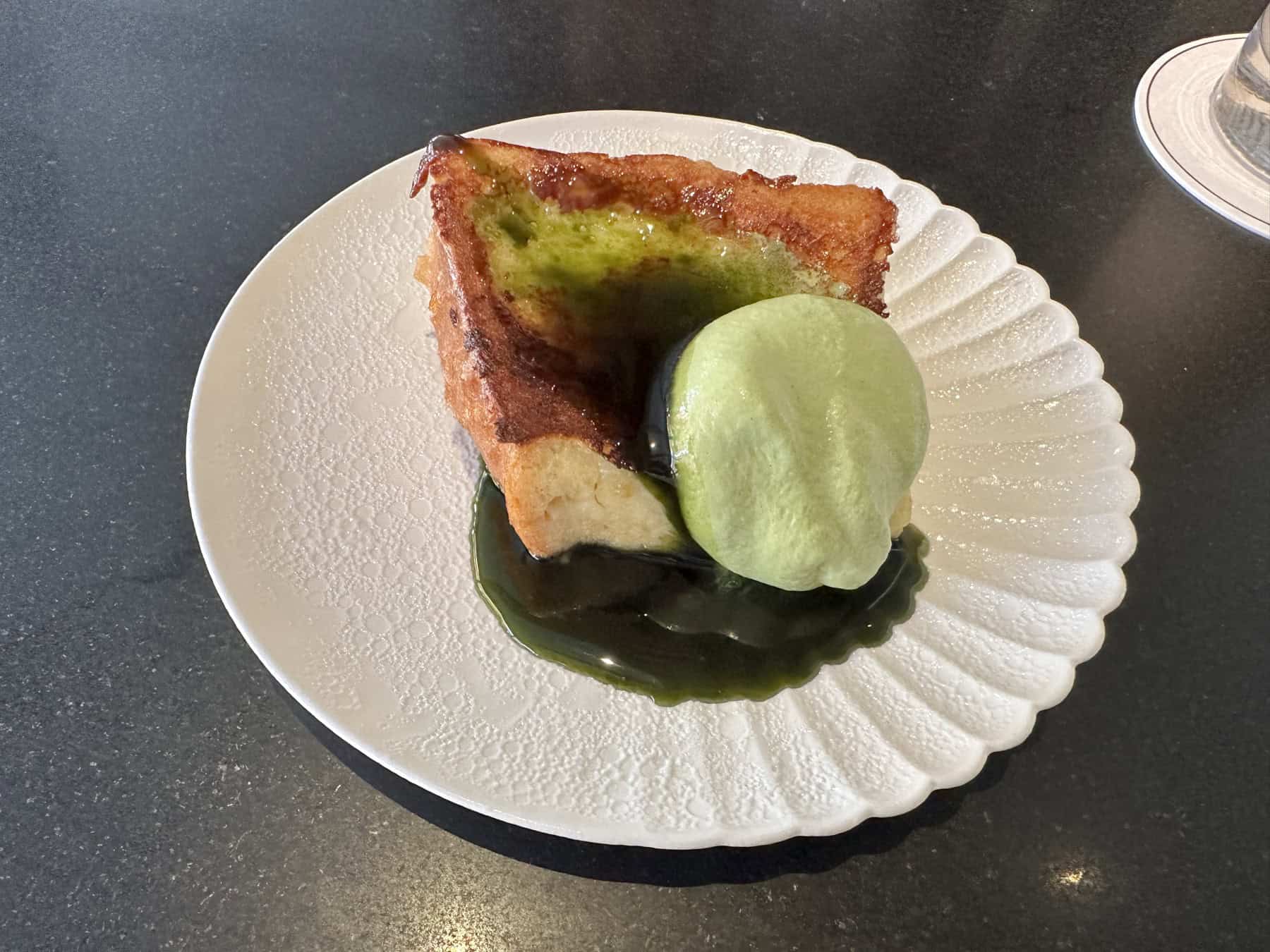
The buffet selection isn't large, but it confidently chooses quality over quantity. There are original drinks and fresh vegetables, and every item is delicious and satisfying. As someone with a sweet tooth, my favorite was the French toast cooked to order right in front of you, served with matcha ice cream. Freshly made and indulgent, I couldn't resist going back for more. Breakfast while gazing at the autumn leaves is a luxury only this location can offer.
Summary: Not "Sightseeing Kyoto," but "Staying in Kyoto's Quiet"
ROKU KYOTO is not a base for visiting famous sights. It is a place where the hotel itself is the destination. Autumn hills, reflections on the water, a course that showcases local ingredients, and (although I missed it this time) a natural hot spring. It condenses Kyoto's quiet into one night, in the form of luxury.
Once again I used a Hilton free night certificate, so the room cost me nothing. That means I can't judge it on price versus value, but I can say with confidence that it is well worth using one of your limited free night certificates on. I plan to keep coming back, and it makes me want to someday book a higher room category with cash for a special occasion like an anniversary.
Who Is ROKU KYOTO For?
- Young couples who want a taste of luxury for a special occasion
- Solo travelers who want to escape the city bustle and slow down
- Couples whose children have grown up and who want to reclaim time for two
As a way to stay in Kyoto's quiet, this is a hotel I can recommend with confidence.
About the author: I'm Mimizuku, a Japan-based Hilton Honors Diamond member who writes about luxury and Hilton hotels in Japan and beyond. This article was originally written in Japanese and translated into English.